AI Governance
From AI Capability to Stakeholder Confidence: The Trust Pillar of STEWARD-AI
Dr. Rajiv Yadav, Ph.D. · STEWARD-AI series · 5 min read
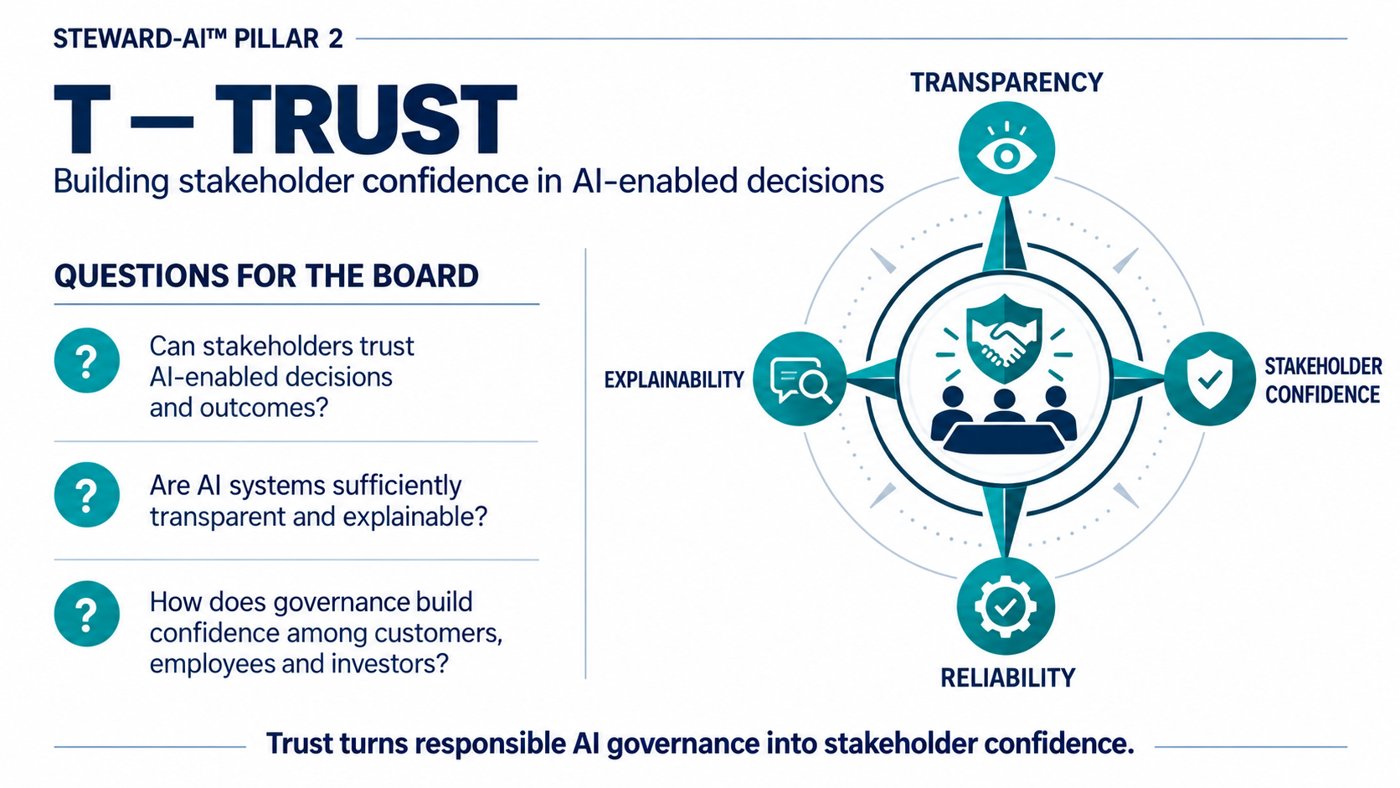
Trust pillar of STEWARD-AI™: Transparency, Stakeholder Confidence, Reliability and Explainability.
Artificial Intelligence can improve decisions, accelerate processes and create new forms of value. Yet organisations will realise these benefits only if the people affected by AI have confidence in how it is designed, governed and used.
Customers must be comfortable engaging with AI-enabled services. Employees need confidence that AI supports responsible workplace decisions. Investors require assurance that adoption is disciplined and aligned with long-term value. Regulators and business partners expect organisations to demonstrate control, accountability and appropriate oversight.
For Boards, trust is therefore not a communications exercise undertaken after an AI system has been deployed. It is a governance outcome that must be designed into the organisation’s approach from the beginning.
This is the focus of the Trust pillar within STEWARD-AI™, a Boardroom Framework for Responsible AI Leadership. The pillar helps Boards assess whether stakeholders can have confidence in AI-enabled decisions and outcomes.
It examines four connected sub-pillars: Transparency, Stakeholder Confidence, Reliability and Explainability.
Trust Must Be Earned
Trust in AI cannot be created through assurances alone. It is earned when an organisation consistently demonstrates that its systems operate as intended, decisions can be understood, responsibilities are clear and concerns are addressed appropriately.
This does not mean that every technical detail must be disclosed to every stakeholder. It means that the organisation provides the right level of information to the right audience. Customers may need to know when they are interacting with AI. Employees may need clarity about how AI affects their work. Regulators may require evidence of governance and control. Boards need confidence that management understands both the capabilities and limitations of important AI systems.
The four Trust sub-pillars provide a practical way to oversee these expectations.
1. Transparency
Transparency begins with visibility. An organisation cannot govern AI effectively if it does not know where AI is being used, what decisions it influences or who is responsible for its outcomes.
Boards should expect management to maintain an appropriate view of material AI applications across the enterprise. This should include their purpose, strategic relevance, intended users, ownership and potential stakeholder impact.
Transparency also concerns communication. Stakeholders should not be misled about the involvement of AI in a service, interaction or decision. Information should be presented clearly enough for the intended audience to understand what the system does, how it is used and what its important limitations may be.
However, transparency does not require the unrestricted disclosure of intellectual property, security-sensitive information or highly technical documentation. Effective governance requires a proportionate approach that balances openness with legitimate business and security considerations.
For the Board, the key question is whether the organisation is sufficiently transparent to support informed oversight and responsible stakeholder engagement.
2. Stakeholder Confidence
Different stakeholders experience AI in different ways. Trust must therefore be considered from more than one perspective.
Customers may value convenience and personalisation but remain concerned about privacy, inappropriate use of information or an inability to challenge a decision. Employees may welcome tools that reduce routine work while worrying about surveillance, job redesign or decisions made without meaningful human involvement. Investors may support AI-led growth but seek assurance that governance, reputation and execution risks are being managed.
Stakeholder confidence depends on whether the organisation understands these expectations and responds through its governance practices. This includes clear accountability, accessible channels for raising concerns, appropriate human oversight and timely action when problems arise.
Boards should ask how management is measuring stakeholder confidence. Complaints, customer feedback, employee sentiment, adoption rates and recurring concerns can provide useful signals. The Board should also consider whether management engages affected stakeholders early enough to shape responsible deployment rather than consulting them only after decisions have been made.
Trust grows when stakeholders see that the organisation listens, learns and acts responsibly.
3. Reliability
An AI system may perform well during testing but behave differently when it encounters new data, changing conditions or unexpected patterns. Reliability is therefore fundamental to trust.
Reliable AI should produce sufficiently consistent and dependable outcomes for its intended purpose. Its performance should be monitored over time, not assumed to remain stable after deployment. Management should define acceptable performance, identify warning indicators and establish processes for intervention when results fall outside agreed boundaries.
The level of assurance should reflect the significance of the use case. A system suggesting internal meeting times does not require the same degree of oversight as one affecting customers’ access to important products or services. Greater potential impact demands stronger testing, monitoring, documentation and human review.
Boards do not need to examine technical performance metrics for every application. They should, however, understand how management determines whether material AI systems remain dependable, how failures are identified and who has authority to pause or withdraw a system when necessary.
Reliability also includes organisational readiness. Clear escalation paths, contingency arrangements and accountable ownership help ensure that the organisation can respond effectively when an AI system does not perform as expected.
4. Explainability
Explainability enables people to understand the basis, significance and limitations of an AI-enabled outcome.
Not every AI model can be explained in the same way, and different audiences require different forms of explanation. A technical team may need detailed information about data and model behaviour. A customer may need a clear reason for an outcome and a route for review. A Board may need to understand the principal decision factors, limitations, potential consequences and controls.
The objective is not to simplify complex systems to the point of being misleading. It is to provide explanations that are accurate, relevant and useful to the person receiving them.
Boards should ask whether important AI-enabled decisions can be explained well enough to support accountability. They should also examine whether individuals can question or challenge consequential outcomes and whether appropriate human judgement remains available.
When decisions cannot be meaningfully explained, the organisation should consider whether that limitation is acceptable for the proposed use.
Turning Trust into Boardroom Oversight
The Trust pillar encourages Boards to ask three fundamental questions:
Can stakeholders trust AI-enabled decisions and outcomes?
Are AI systems sufficiently transparent and explainable?
How does governance build confidence among customers, employees and investors?
These questions move the Board discussion beyond technical capability and toward the quality of the organisation’s relationship with its stakeholders.
Trust should not be treated as a fixed achievement. It can strengthen through responsible behaviour and weaken quickly through inconsistency, poor communication or unmanaged failures. Boards therefore need regular insight into how trust is being created, monitored and protected.
AI adoption may begin with technology, but sustainable adoption depends on confidence. By strengthening transparency, stakeholder confidence, reliability and explainability, the STEWARD-AI Trust pillar helps Boards ensure that AI-enabled value is supported by responsible governance—and by the trust of the people it is intended to serve.
About the author: Dr. Rajiv Yadav is an international Board Strategy & Governance Advisor and Global Thought Leader in Board Stewardship, with more than 35 years of boardroom and executive leadership experience across four continents. He is the creator of STEWARD-AI™.