AI Governance
From AI Capability to Responsible Outcomes: The Ethics Pillar of STEWARD-AI
Dr. Rajiv Yadav, Ph.D. · STEWARD-AI series · 6 min read
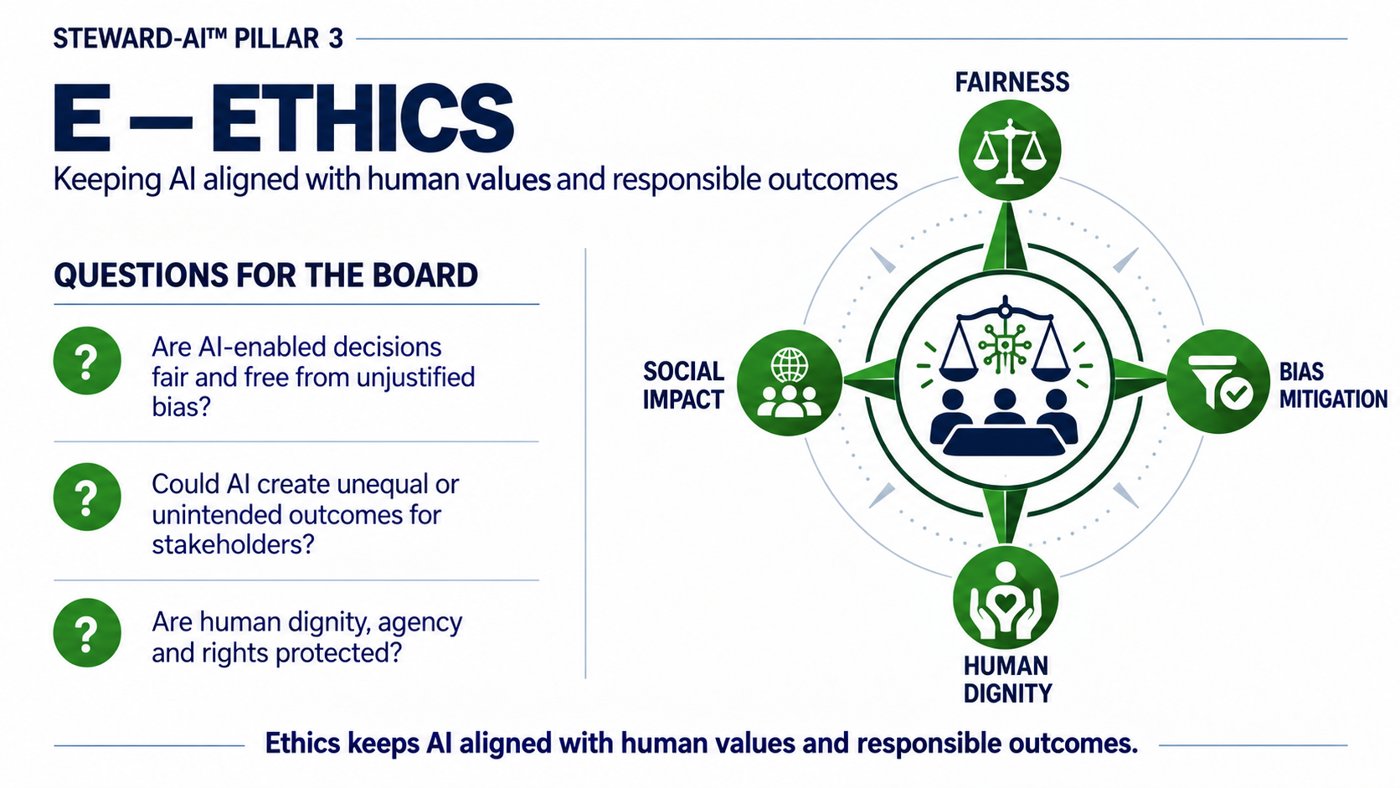
Ethics pillar of STEWARD-AI™: Fairness, Bias Mitigation, Human Dignity and Social Impact.
Artificial Intelligence increasingly influences decisions that affect customers, employees, investors and communities. It can determine what information people see, which opportunities they receive, how services are delivered and how organisations allocate resources.
These capabilities create substantial value, but they also raise an important Board-level question: Just because an organisation can use AI in a particular way, should it?
Legal compliance provides part of the answer, but not all of it. An AI-enabled decision may satisfy existing rules and still produce outcomes that stakeholders consider unfair, intrusive or inconsistent with the organisation’s values. Regulations may also develop more slowly than technology, leaving Boards and management to exercise judgement where formal requirements remain unclear.
This is the purpose of the Ethics pillar within STEWARD-AI™, a Boardroom Framework for Responsible AI Leadership. It helps Boards consider whether AI is aligned with human values and whether its outcomes can be regarded as responsible, not merely efficient.
The Ethics pillar comprises four connected elements: Fairness, Bias Mitigation, Human Dignity and Social Impact.
Ethics Is a Governance Responsibility
Ethical AI is sometimes treated as a technical matter to be managed by data scientists or compliance teams. While technical expertise is essential, the underlying questions often concern organisational purpose, stakeholder impact and acceptable conduct. These matters ultimately require leadership judgement and effective Board oversight.
The Board does not need to approve every model or resolve every ethical dilemma. It should, however, ensure that management has established clear principles, decision responsibilities and escalation mechanisms. It should also expect evidence that ethical considerations are addressed throughout the AI lifecycle—from identifying a use case and selecting data to testing, deployment, monitoring and eventual withdrawal.
The four Ethics elements provide a practical structure for this oversight.
1. Fairness
Fairness considers whether AI-enabled decisions treat people and groups appropriately and whether comparable situations produce reasonably consistent outcomes.
This does not always mean that everyone must receive an identical result. Different circumstances may justify different outcomes. The important question is whether those differences are relevant, proportionate and consistent with the organisation’s values and responsibilities.
Boards should ask management how fairness is defined for material AI applications. An organisation using AI in recruitment, lending, insurance, healthcare or employee evaluation may need to consider fairness differently in each context. A single general statement is unlikely to be sufficient.
Fairness also requires attention to who benefits from an AI system and who may be disadvantaged. An initiative may improve efficiency for the organisation while making a service less accessible to certain customers. A model may perform well overall while producing weaker outcomes for particular groups.
Board oversight should therefore look beyond average performance. Directors should seek assurance that management has considered how outcomes vary among relevant stakeholder groups and whether any differences can be justified and addressed.
2. Bias Mitigation
AI systems learn from data and reflect choices made during their design, development and use. If historical data contains inequalities, incomplete representation or inappropriate assumptions, an AI system may reproduce or amplify those patterns.
Bias can also arise after deployment. Customer behaviour may change, market conditions may shift or a system may be used for a purpose different from the one for which it was originally tested.
Bias mitigation begins with recognising that no data set or model is automatically neutral. Organisations need processes to identify possible sources of bias, assess their significance and take appropriate corrective action.
Boards are not expected to review technical testing in detail. They should nevertheless ask whether material systems have been examined for unjustified bias, whether relevant groups are represented in testing and whether performance is monitored over time.
Management should also be able to explain who decides when a difference in outcomes becomes unacceptable, how concerns are escalated and whether there is authority to pause or modify a system.
Bias mitigation is not a one-time certification. It is an ongoing governance discipline that requires evidence, monitoring and accountable judgement.
3. Human Dignity
AI should support human wellbeing rather than reduce people to data points or remove meaningful human agency from consequential decisions.
Human dignity concerns how people are treated when AI is used. Are they informed appropriately? Is their privacy respected? Can they question an outcome? Is human review available when the consequences are significant? Does the system preserve choice, or does it manipulate behaviour in ways individuals may not recognise?
These questions are particularly important when AI affects employment, financial access, healthcare, education or essential services. Efficiency alone cannot justify removing human consideration from decisions that materially affect a person’s life or opportunities.
Boards should ask whether the organisation has identified situations in which human judgement must remain central. Human involvement should be meaningful rather than ceremonial. A reviewer needs adequate information, authority and time to challenge an AI-generated recommendation.
The Board should also consider employee dignity. AI may improve productivity, but workplace deployment can create concerns about excessive monitoring, loss of autonomy or unclear accountability. Responsible adoption requires open communication, appropriate consultation and thoughtful redesign of work.
Protecting human dignity establishes boundaries around how the organisation will use AI—even when a particular application may be technically possible.
4. Social Impact
An organisation’s use of AI can affect people beyond its immediate customers and employees. At scale, AI may influence access to information, patterns of employment, community wellbeing, environmental resources and public confidence in institutions.
The Social Impact element encourages Boards to examine these wider and longer-term consequences.
Management should consider both intended and unintended effects. An AI system designed to improve access may inadvertently exclude individuals with limited digital capability. Automated content generation may increase efficiency while contributing to misinformation. Large-scale AI infrastructure may also create environmental implications that deserve consideration.
Not every possible effect can be predicted. The objective is not to eliminate all uncertainty, but to ensure that material social consequences are considered before deployment and monitored afterwards.
Boards should ask whether affected communities and stakeholder perspectives have been considered, particularly when an AI initiative could influence vulnerable groups. They should also expect management to respond when evidence shows that actual impact differs from what was anticipated.
Responsible organisations look beyond whether an AI system works. They consider what its use means for the wider environment in which the organisation operates.
Turning Ethics into Boardroom Oversight
The Ethics pillar encourages Boards to ask three fundamental questions:
Are AI-enabled decisions fair and free from unjustified bias?
Could AI create unequal or unintended outcomes for stakeholders?
Are human dignity, agency and rights protected?
These questions help Directors examine the consequences of AI decisions, not merely their technical performance or financial return.
Ethical governance should not be viewed as an obstacle to innovation. Clear principles and decision boundaries can give management greater confidence to innovate responsibly. They reduce uncertainty, strengthen accountability and help identify concerns before they become significant stakeholder or reputational problems.
AI will continue to create situations in which there is no simple or universally accepted answer. The quality of an organisation’s response will depend on the judgement, values and governance it brings to those situations.
By focusing on Fairness, Bias Mitigation, Human Dignity and Social Impact, the STEWARD-AI Ethics pillar helps Boards ensure that AI-enabled progress remains aligned with responsible outcomes—and with the people and communities the organisation ultimately serves.
About the author: Dr. Rajiv Yadav is an international Board Strategy & Governance Advisor and Global Thought Leader in Board Stewardship, with more than 35 years of boardroom and executive leadership experience across four continents. He is the creator of STEWARD-AI™.