AI Governance
From AI Uncertainty to Organisational Resilience: The Risk Pillar of STEWARD-AI
Dr. Rajiv Yadav · STEWARD-AI series · 5 min read
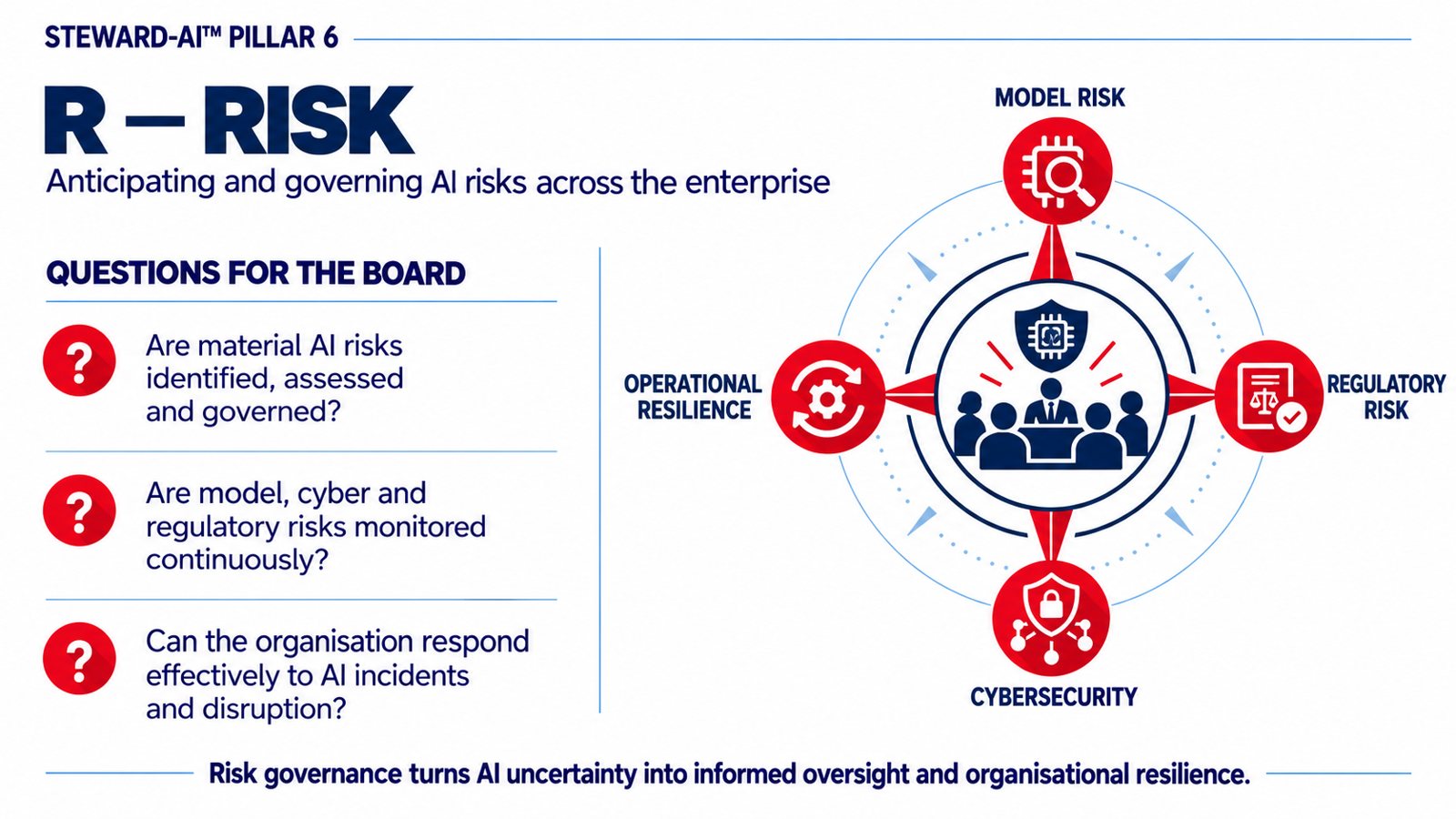
Risk pillar of STEWARD-AI™: Model Risk, Regulatory Risk, Cybersecurity and Operational Resilience.
Artificial intelligence can improve speed, insight and efficiency, but it also changes the organisation's exposure to risk. AI systems may produce inaccurate outputs, behave differently as data changes, create new cyber vulnerabilities or become inconsistent with regulatory expectations. Because AI is often embedded in business processes and supplied through external platforms, a weakness in one system can affect customers, employees, operations and reputation at the same time.
For Boards, the task is not to eliminate every risk. It is to ensure that management understands material AI exposures, makes deliberate choices within the organisation's risk appetite and can respond when systems fail or conditions change. Oversight must cover the full lifecycle, from the decision to adopt an AI use case through testing, deployment, monitoring, incident response and retirement.
This is the focus of the Risk pillar within STEWARD-AI™, a Boardroom Framework for Responsible AI Leadership. It gives Directors a practical way to examine whether AI risks are identified, assessed, monitored and governed. The pillar comprises four connected dimensions: Model Risk, Regulatory Risk, Cybersecurity, and Operational Resilience.
Why AI Risk Requires Board Attention
AI risk does not belong to one function. A material use case may involve a business owner, technology and data teams, legal and compliance specialists, cybersecurity, operational risk, internal audit and external providers. These parties see different parts of the exposure. The Board needs assurance that management brings those views together and identifies dependencies that may otherwise remain hidden.
Risk oversight should also be proportionate. A tool that summarises internal notes does not require the same control as a system that influences credit, employment, healthcare, safety or access to essential services. Management should classify use cases by potential impact and apply stronger validation, monitoring and approval where the consequences are greater.
1. Model Risk
Model risk arises when an AI system produces unreliable, misleading or inappropriate results. The cause may lie in poor data, flawed assumptions, weak design, an unsuitable use case or changes in the environment after deployment. Generative AI adds further concerns because outputs may sound convincing even when they are incomplete or incorrect.
Management should define the system's intended purpose, acceptable performance and limits before approval. Material models require suitable testing, independent challenge and ongoing monitoring for deterioration or unexpected behaviour. Human review should be meaningful where an error could materially affect a person or the organisation, and someone must have authority to restrict or stop the system when performance moves outside agreed boundaries.
Key Board question: Are material AI models tested, monitored and challenged in proportion to their potential impact?
2. Regulatory Risk
Regulatory risk arises because requirements for AI continue to develop across jurisdictions and sectors. An organisation may face obligations relating to consumer protection, privacy, discrimination, cybersecurity, record keeping, explainability or sector-specific conduct. The applicable duty may also depend on whether the organisation develops, supplies or uses the system.
Boards should expect management to maintain a clear view of material obligations and proposed changes that could affect strategy or operations. High-impact use cases need adequate documentation, traceable approvals and evidence that controls operate as intended. The organisation should also assess whether vendor contracts provide the information, access and cooperation required to meet its own responsibilities.
Key Board question: Can the organisation demonstrate compliance as AI requirements and supervisory expectations evolve?
3. Cybersecurity
AI expands the cyber risk surface. Sensitive information may be disclosed through prompts or outputs. Training data can be manipulated, models can be targeted or copied, and malicious inputs can cause a system to behave in unintended ways. Dependence on cloud services, application interfaces and third-party models also introduces supply-chain exposure.
These risks should be integrated into the organisation's established cybersecurity governance rather than managed as a separate technical issue. Controls should address access, data protection, secure development, vendor assurance, monitoring and incident response. Boards should also ask whether existing cyber scenarios account for AI-specific failures and whether management can determine which systems, data and stakeholders are affected during an incident.
Key Board question: Are AI-related cyber and third-party risks included in enterprise security oversight and incident planning?
4. Operational Resilience
AI may become part of customer service, fraud detection, scheduling, decision support and other critical operations. If a model becomes unavailable, a provider changes its service, data quality deteriorates or performance fails under new conditions, the disruption can spread quickly through connected processes.
Operational resilience requires the organisation to understand these dependencies and prepare workable alternatives. Critical uses should have recovery arrangements, manual fallbacks where appropriate and clear authority for pausing or replacing a system. Concentration risk also deserves attention when several important processes depend on the same provider, model or data source. Resilience testing should examine realistic business consequences, not only whether the technology can be restarted.
Key Board question: Can the organisation continue critical activities and protect stakeholders when an AI system fails or becomes unavailable?
Turning Risk into Boardroom Oversight
The Risk pillar is connected to the other STEWARD-AI pillars but has a distinct purpose. Strategy considers where AI should create value. Trust and Ethics address confidence and responsible outcomes. Workforce examines human and organisational readiness. Accountability clarifies authority and responsibility. Risk focuses on uncertainty, potential harm or loss, control effectiveness and the organisation's capacity to recover.
The Risk pillar encourages Boards to keep three questions at the centre of their oversight:
Are material AI risks identified, assessed and governed?
Are model, cyber and regulatory risks monitored continuously?
Can the organisation respond effectively to AI incidents and disruption?
These questions help Directors test whether risk governance keeps pace with adoption. Useful reporting should show the organisation's most significant AI use cases, their risk classification, accountable owners, key control issues, incidents and remediation. It should also identify emerging dependencies and explain where exposure exceeds agreed limits.
Boards do not need to review the technical detail of every model or security control. They do need evidence that material risks are visible, ownership is clear, controls are tested and management can act promptly when conditions change. When those disciplines are in place, the organisation can pursue AI opportunities without treating resilience as an afterthought.
About the author: Dr. Rajiv Yadav is an international Board Strategy & Governance Advisor with more than 35 years of boardroom and executive leadership experience across Asia, Europe, the Americas and Australia in banking, financial services, infrastructure, insurance and technology. He is the creator of STEWARD-AI™.